Showing posts with label #Big Data. Show all posts

Saturday, November 28, 2020

Difference Between Spark and Hadoop

 Spark and Hadoop are big data frameworks, but they don’t serve the same features. Spark is a data processing tool that works on data collections and doesn’t do distributed storage. Hadoop, on the other hand, is a distributed infrastructure, supports the processing and storage of large data sets in a computing environment.

In order to have a glance on difference between Spark vs Hadoop, I think an article explaining the pros and cons of Spark and Hadoop might be useful.


What is Spark?

A fast engine for large data-scale processing, Spark is said to work faster than Hadoop in a few circumstances. It doesn’t have its own system to organize files in a distributed ways. Its big claim to fame is real time data processing compared to batch processing engine. It is basically a cluster-computing framework, which signifies that it completes more with MapReduce than the whole Hadoop ecosystem.

Advantage of Spark

  • Perfect for interactive processing, iterative processing and event steam processing
  • Flexible and powerful
  • Supports for sophisticated analytics
  • Executes batch processing jobs faster than MapReduce
  • Run on Hadoop alongside other tools in the Hadoop ecosystem

Disadvantage of Spark

  • Consumes a lot of memory
  • Issues with small file
  • Less number of algorithms
  • Higher latency compared to Apache fling
Also Read Big Data online Course  Tutorails Here

Reasons to learn Spark

2017 is the time to learn spark and upgrade your skills. Developers earn highest average salary among other experts using the most popular development tools. Some of the other reasons are:

  • Opens up various opportunities for big data exploration and making it easier for companies to solve various kinds of big data issues
  • Organizations are on the verge of hiring huge number of spark developers
  • Provides increased data processing speed compared to Hadoop
  • Professionals who have experience with Apache spark can earn the highest average salaries

What is Hadoop?

A framework that enables for distributed processing of large data sets using simple programming models, Hadoop has emerged as a new buzzword to fill a real need that arose in companies to analyze, process and collect data. It is resilient to system faults since data are written to disk after every operation. Hadoop is comprised of the various modules that work together to create the Hadoop framework. Some of the Hadoop framework modules are Hive, YARN, Cassandra and Oozie.

Advantage of Hadoop

  • Cost effective
  • Processing operation is done at a faster speed
  • Best to be applied when a company is having a data diversity to be processed
  • Creates multiple copies
  • Saves time and can derive data from any form of data

Disadvantage of Hadoop

  • Can’t perform in small data environments
  • Built entirely on java
  • Lack of preventive measures
  • Potential stability issues
  • Not fit for small data

Reasons to learn Hadoop

With the use of Hadoop, Companies can store all the data generated by their business at a reasonable price. Even, professional Hadoop training can help you meet the competitive advantage. Some reasons to learn Hadoop so that experts can exploit the lucrative career opportunities in the big data market.

  • Brings in better career opportunities in 2017
  • An exciting part of the big data world to meet the challenges of the fast growing big data market
  • The job listings on sites like indeed.com show the increased demand for Hadoop professionals
  • Hadoop is an essential piece of every organization’s business technology agenda

Many experts argue that spark is better than Hadoop or Hadoop is better than spark. In my opinion, both are not competitors. Spark is used to deal with data that fits in the memory, whereas Hadoop is designed to deal with data that doesn’t fit in the memory.

To more info go through  OnlineITguru's Big Data Hadoop Course

Thursday, November 26, 2020

Explain HDFS data read and write operations in Hadoop

 Once you read several models, HDFS follows Write. So we can't edit files already stored in HDFS, but by reopening the file, we can append info. Interact with the Name node in the Read-Write Operation Client first. In this article, we will discuss the internal reading and writing operations of Hadoop HDFS data. We will also discuss how clients read and write HDFS data, how clients communicate with master and slave nodes in the read, and write operations for HDFS data,More info go through Big Data online Course Tutorials Blog.

Read and Write Operations for Hadoop HDFS Data

The Hadoop storage layer is the HDFS-Hadoop Distributed File System. It is the planet's most reliable storage system. Name node is the master daemon running on the master node, Data node is the slave daemon running on the slave node, and HDFS operates in master-slave fashion.

You can install Hadoop before you start to use HDFS. I advise you to—

Here we are going to cover the read and write operations of HDFS results. Let's first talk about the HDFS file writing process followed by the HDFS file reading operation—

Action with Hadoop HDFS Data Write

A client needs to communicate with the master, i.e. namenode, to write a file in HDFS (master). Name node now provides the address of the data nodes (slaves) that the client begins writing the data on. The client writes data directly to the data nodes, and now the data node builds the pipeline for data writing.

The first data node copies the block to another data node, which copies it to the third data node internally. After it generates the replicas of bricks, the acknowledgment is sent back.

a. Pipeline Hadoop Workflow HDFS Data Write

Let's now grasp the full HDFS data writing pipeline end-to-end. The HDFS client sends a Distributed File System APIs development request.

(ii) Distributed File System makes a name node RPC call to create a new file in the namespace of the file system.

To ensure that the file does not already exist and that the client has the permission to create the file, the name node performs several tests. Then only the name node allows a record of the new file when these checks pass; otherwise, file creation fails and an IOException is thrown at the client. Read in-depth about Hadoop HDFS Architecture, too.

(iii) The Distributed File System returns an FSData Output Stream to start writing data to the device. DFS Output Stream divides it into packets, which it writes to an internal queue, called a data queue, while the client writes data. 

iv) A Hadoop pipeline is made up of a list of data nodes, and here we can presume that the degree of replication is three, so there are three nodes in the pipeline. Similarly, a packet is stored and forwarded to the third (and last) data node in the pipeline by the second data node. Read in-depth about HDFS Data Blocks.

V) A packet is only deleted from the ack queue when the data nodes in the pipeline have been recognized. Once necessary replicas are made, the Data node sends the recognition (3 by default). Similarly, all the blocks are stored and replicated on the various data nodes and copied in parallel with the data blocks.

Vi) It calls close() on the stream when the client has finished writing data.

Vii) This action flushes all remaining packets to the pipeline of the data node and waits for acknowledgments to signal that the file is complete before contacting the name node. 

From the following diagram, we can summarise the HDFS data writing operation.

b. How to write a Hadoop HDFS-Java Program file

Follow this HDFS command part 1 to communicate with HDFS and perform various operations.

[php]FileSystem fileSystem = FileSystem.get(conf); = FileSystem.get(conf)

/ Check if a file already exists

Path = New Path('/path/to/file.ext'););

If (path.exists(fileSystem)) {

System.out.println("File "+ dest +" exists already");

Returning;

}

/ Generate and write data to a new file.

OutputFSDataStream= fileSystem.create(path);

InputStream to = new BufferedInputStream(new FileInputStream()

File(source))););;

Byte[] b = new byte[1024];; new byte[1024]

= 0; int numBytes;

Whereas ((numBytes = in.read(b)) > 0) { = in.read(b))

Out.write(b, 0, and numBytes);

}

/ Close all descriptors for files

Within.close();

Out.close();;-)

Close(); fileSystem.close();

[/php] PHP


Operation Read of Hadoop HDFS Data

A client needs to communicate with the name node (master) to read a file from HDFS because the name node is the core of the Hadoop cluster (it stores all the metadata i.e. data about the data). Now if the client has enough privileges, the name node checks for the necessary privileges, then the name node provides the address of the slaves where a file is stored. In order to read the data blocks, the client can now communicate directly with the respective data nodes.

HDFS Workflow Read File in Hadoop

Let's now understand the complete operation of reading HDFS data from end to end. The data read process in HDFS distributes, the client reads the data from data nodes in parallel, the data read cycle explained step by step.

The client opens the file it wants to read by calling open() on the File System object, which is the Distributed File System instance for HDFS. See HDFS Data Read Process

(ii) Distributed File System uses RPC to call the name node to decide the block positions for the first few blocks in the file. 

Iii) Distributed File System returns to the client an FSDataInputStream from which it can read data. Therefore, FSDataInputStream wraps the DFSInputStream that handles the I/O of the data node and name node. On the stream, the client calls read(). The DFSInputStream that has stored the addresses of the data node then connects to the first block in the file with the nearest data node.

iv) Data is streamed back to the client from the data node, which enables the client to repeatedly call read() on the stream. When the block ends, the connection to the data node is closed by DFSInputStream and then the best data node for the next block is found. Learn about the HDFS data writing operation as well.

V) If an error is encountered by DFSInputStream while interacting with a data node, the next closest one will be tried for that block. Data nodes that have failed will also be remembered so that they do not needlessly retry them for later blocks. Checksums for the data transferred to it from the data node are also checked by the DFSInputStream. If a corrupt block is detected, the name node will report this before the DFSInputStream tries to read a replica of the block from another data node.vi) When the client has finished reading the data, the stream will call close().

From the following diagram, we can summarise the HDFS data reading operation.


b. How to Read an HDFS-Java Program File in Hadoop

The following is a sample code to read a file from HDFS (Follow this HDFS command component to perform HDFS read and write operations-3):

[php]FileSystem fileSystem = FileSystem.get(conf); = FileSystem.get(conf)

Path = New Path('/path/to/file.ext'););

If, for example, (!fileSystem.exists(path)) {

System.out.println('File is not present');;

Returning;

}

In = fileSystem.open(path); FSDataInputStream

= 0; int numBytes;

Whereas ((numBytes = in.read(b))> 0) {

System.out.prinln((char)numBytes));/ code that is used to control the read data

}

Within.close();

Out.close();;-)

Close();[/php]; fileSystem.close()

HDFS Fault Tolerance in Hadoop

The part of the pipeline running a data node process fails. Hadoop has an advanced feature to manage this situation (HDFS is fault-tolerant). If a data node fails when data is written to it the following steps are taken, which are clear to the customer writing the details.

A new identity is given to the current block on the successful data node, which is transmitted to the name node so that if the failed data node recovery is later, the partial block on the failed data node is removed. Read High Accessibility in HDFS Name node also.

The failed data node is removed from the pipeline, and the remaining data from the block is written to the two successful data nodes in the pipeline.

Conclusion

In conclusion, this design enables HDFS to increase customer numbers. This is because all the cluster data nodes are spread by data traffic. It also offers high availability, rack recognition, coding for erasure, etc as a consequence, it empowers Hadoop.

If you like this post or have any queries about reading and writing operations for HDFS info, please leave a comment. We'll be able to get them solved. You can learn more through Big Data and Hadoop Training

Tuesday, November 24, 2020

Five ways to handle Big Data in R


What data is big?

 In traditional analysis, the development of a statistical model takes more time than the calculation by the computer. When it comes to Big Data this proportion is turned upside down. Big Data comes into play when the CPU time for the calculation takes longer than the cognitive process of designing a model.

 As a rule of thumb: Data sets that contain up to one million records can easily processed with standard R. Data sets with about one million to one billion records can also be processed in R, but need some additional effort. Data sets that contain more than one billion records need to be analyzed by map reduce algorithms. These algorithms can be designed in R and processed with connectors to Hadoop and the like.

The number of records of a data set is just a rough estimator of the data size though. It’s not about the size of the original data set, but about the size of the biggest object created during the analysis process. Depending on the analysis type, a relatively small data set can lead to very large objects. To give an example: The distance matrix in hierarchical cluster analysis on 10.000 records contains almost 50 Million distances.

To learn complete big data hadoop course visit ITGuru's big data and hadoop online training Blog

Big Data Strategies in R

If Big Data has to be tackle with R, five different strategies can be considered:

Sampling

If data is too big to be analyzed in complete, its’ size can be reduced by sampling. Naturally, the question arises whether sampling decreases the performance of a model significantly. Much data is of course always better than little data. But according to Hadley Wickham’s useR! talk, sample based model building is acceptable, at least if the size of data crosses the one billion record threshold.

If sampling can be avoided it is recommendable to use another Big Data strategy. But if for whatever reason sampling is necessary, it still can lead to satisfying models, especially if the sample is

  • still (kind of) big in total numbers,
  • not too small in proportion to the full data set,
  • not biased.

Bigger hardware

R keeps all objects in memory. This can become a problem if the data gets large. One of the easiest ways to deal with Big Data in R is simply to increase the machine’s memory. Today, R can address 8 TB of RAM if it runs on 64-bit machines. That is in many situations a sufficient improvement compared to about 2 GB addressable RAM on 32-bit machines.

Store objects on hard disc and analyze it chunkwise

As an alternative, there are packages available that avoid storing data in memory. Instead, objects are stored on hard disc and analyzed chunkwise. As a side effect, the chunking also leads naturally to parallelization, if the algorithms allow parallel analysis of the chunks in principle. A downside of this strategy is that only those algorithms (and R functions in general) can be performed that are explicitly designed to deal with hard disc specific datatypes.

“ff” and “ffbase” are probably the most famous CRAN packages following this principle. Revolution R Enterprise, as a commercial product, uses this strategy with their popular “scaleR” package as well. Compared to ff and ffbase, Revolution scaleR offers a wider range and faster growth of analytic functions. For instance, the Random Forest algorithm has recently been added to the scaleR function set, which is not yet available in ffbase.


Integration of higher performing programming languages like C++ or Java

The integration of high performance programming languages is another alternative. Small parts of the program are moved from R to another language to avoid bottlenecks and performance expensive procedures. The aim is to balance R’s more elegant way to deal with data on the one hand and the higher performance of other languages on the other hand.

The outsourcing of code chunks from R to another language can easily be hidden in functions. In this case, proficiency in other programming languages is mandatory for the developers, but not for the users of these functions.

rJava, a connection package of R and Java, is an example of this kind. Many R-packages take advantage of it, mostly invisible for the users. RCPP, the integration of C++ and R, has gained some attention recently as Dirk Eddelbuettel has published his book “Seamless R and C++ Integration with RCPP” in the popular Springer series “UseR!”. In addition, Hadley Wickham has added a chapter on RCPP in his book “Advanced R development”, which will be published early 2014. It is relatively easy to outsource code from R to C++ with RCPP. A basic understanding of C++ is sufficient to make use of it.


Alternative interpreters

A relatively new direction to deal with Big Data in R is to use alternative interpreters. The first one that became popular to a bigger audience was pqR(pretty quick R). Duncon Murdoc from the R-Core team preannounced that pqR’s suggestions for improvements shall be integrated into the core of R in one of the next versions.

Another very ambitioned Open-Source project is Renjin. Renjin reimplements the R interpreter in Java, so it can run on the Java Virtual Machine (JVM). This may sound like a Sisyphean task but it is progressing astonishingly fast. A major milestone in the development of Renjin is scheduled for the end of 2013.

Tibco created a C++ based interpreter called TERR. Beside the language, TERR differs from Renjin in the way how object references are modeled. TERR is available for free for scientific and testing purposes. Enterprises have to purchase a licensed version if they use TERR in production mode.

Another alternative R-interpreter is offered by Oracle. Oracle R uses Intel’s mathematic library and therefore achieves a higher performance without changing R’s core. Besides from the interpreter which is free to use, Oracle offers Oracle R Enterprise, a component of Oracles “Advanced analytic” database option. It allows to run any R code on the database server and has a rich set of functions that are optimized for high performance in-database computation. Those optimized function cover – beside data management operations and traditional statistic tasks – a wide range of data-mining algorithms like SVM, Neural Networks, Decision Trees etc.

Conclusion

A couple of years ago, R had the reputation of not being able to handle Big Data at all – and it probably still has for users sticking on other statistical software. But today, there are a number of quite different Big Data approaches available. Which one fits best depends on the specifics of the given problem. There is not one solution for all problems. But there is some solution for any problem,More info go through big data online course

Thursday, November 19, 2020

Data Processing in Hadoop

 You need a general purpose frame for your cluster. It is because all other types of systems can address a particular use case (e.g., graph processing, machine learning, etc.) and are not adequate by themselves to manage the variety of computing needs that are likely to occur in the organization. In comparison,

many of the other frameworks depend on common-purpose frameworks. Also the special-purpose frameworks that don't build on general-purpose frameworks also depend on their bits and pieces.more info go through Big Data Hadoop Course,

Hadoop Frameworks
MapReduce, Spark, and Tez are the traditional frameworks in this category — and newer frameworks, such as Apache Flink, are emerging. Usually MapReduce is still built on clusters as of today. Certain general purpose systems, including input / output formats, rely on bits and pieces from the MapReduce stack. Nonetheless, other frameworks such as Tez or Spark can still be used without having MapReduce built on your cluster.

MapReduce is the most advanced, but it is the slowest, arguably. Both Spark and Tez are DAG systems and don't have the overhead of running a Map often accompanied by a Reduce job; both are more versatile than MapReduce. Spark is one of the Hadoop ecosystem's most successful ventures, and has a lot of traction. It's considered by many to be MapReduce 's successor — I advise you to use Spark over MapReduce whenever possible.

Notably, MapReduce and Spark have different APIs. That means you'll have to rewrite your jobs in Spark because you're using an abstraction system, if you're switching from MapReduce to Spark. It's also worth noting that while Spark is a general-purpose engine built on it with other abstraction systems, it also offers high-level processing APIs. Spark API can therefore also be seen as an abstraction system itself in this way. The amount of time and code needed to write a Spark job is therefore typically much less than writing an equivalent MapReduce job.

At this level, Tez is better suited to building abstraction frameworks as a framework, rather than developing applications using its API.

The important thing to remember is that just because you have a general purpose processing system built on your cluster doesn't mean you need to write all of your processing jobs using the API of that system. In general, it is recommended that abstraction frameworks (e.g., Pig, Crunch, Cascading) or SQL frameworks (e.g., Hive and Impala) be used whenever possible for writing processing jobs (there are two exceptions to this rule, as discussed in the next section).

Hadoop Abstraction and SQL frameworks:

Abstraction frameworks (e.g., Pig, Crunch, and Cascading) and SQL frameworks (e.g., Hive and Impala) minimize the amount of time spent explicitly writing jobs for general-purpose frames in Hadoop.
Abstraction frameworks:

Pig is an abstraction system which can run on MapReduce, Spark, or Tez as seen in the diagram above.
Apache Crunch offers a higher level API for performing MapReduce or Spark jobs. Cascading is another abstraction system based on the API, which can run on either MapReduce or Tez.
SQL frameworks:
Hive can run on top of MapReduce or Tez as far as SQL engines go, and work is under way to make Hive run on Spark. There are several SQL engines specially designed for faster SQL, including Impala, Presto and Apache Drill.

Main points about the benefits of using an Hadoop abstraction or SQL framework:
You can save a lot of time by not needing to use the low-level APIs of general purpose systems to implement common processing tasks.
You may change the underlying frameworks (as required and applicable) for general purpose processing.
Coding directly on the frame means that if you decided to change systems, you would have to rewrite your jobs. Using an abstraction or SQL framework which builds on abstracts that away from a generic framework.
Running a job on an abstraction or SQL system needs just a small percentage of the overhead needed for an equivalent job written directly within the framework of general purpose. Also, running a query on a special purpose processing system ( e.g., Impala, or Presto for SQL) is much faster than running an equivalent MapReduce task, as they use a completely different execution model, designed to run fast SQL queries.
Hadoop Two examples, where a general purpose system can be used:
If you have other data (i.e. metadata) information that can not be expressed and exploited in an abstraction or SQL system. For example, if you construct a logical data set in an abstraction or SQL system, let 's assume that your data set is partitioned or ordered in a specific way that you can not express. Using such partitioning / sorting metadata in your job can also speed up processing. In such a scenario it makes sense to program directly inside a general-purpose processing framework's low-level API. In such situations, the time savings of running a job over and over again more than the extra time for growth pays off.
If a general purpose design is better suited to your use case. Generally there is a small percentage of use cases where the analysis is very complex and can not easily be represented in a DSL such as SQL or Pig Latin. Crunch and Cascading should be considered in these situations, but sometimes you can only need to program directly using a general purpose processing system.
If you have chosen to use an abstraction or SQL framework, which specific framework you typically use depends on the in-house knowledge and experience.

Chart, machine learning, and real-time frameworks/streaming
Generally there is no need to ask users to follow graphs, machine learning and real-time / streaming systems. If a particular case of use is important to you, you will probably need to use a system that will solve the case.
Hadoop Frames in maps
The popular graph processing frameworks include Giraph,

GraphX, and GraphLab. Apache Giraph is a library running on MapReduce.
GraphX is a graph processing library running on Spark.
Graph Lab was a stand-alone, special purpose graph processing system now capable of handling tabular data as well.
Hadoop Frameworks for machine learning
Mahout, MLlib, Oryx, and H2O are widely used as frameworks for machine learning.
Mahout is a library on top of MapReduce, though plans are being made to get Mahout running on Spark.
MLlib is Spark's machine-learning library.
Oryx and H2O are machine learning engines which are stand-alone, special purpose.
Framework for real-time / streaming
Spark Streaming and Storm + Trident are widely used mechanisms for quasi-real-time data processing.

Spark Streaming is a micro-batch streaming research library which is built on top of Spark.
Apache Storm is a special purpose, distributed, real-time computing engine with Trident being used on top of that as an abstraction engine.
Hadoop Partitions:
Partition means dividing a table into coarse grained parts based on a column value like 'information.' It makes it easier to do queries on data slices Hive Data Samples
What is Partition 's function, then?

Determines how data is stored by the partition keys. Each single value of the Partition key here determines a table partition. For simplicity the Partitions are numbered after the dates. This is close to HDFS's 'Block Splitting.'
Buckets:
Buckets offer the data extra structure which can be used for efficient queries. A combination of two tables bucketed on the same columns can be enforced as a Map-Side Combination, including the join column. Bucketing by the used ID means we can test a user-based query easily by running it on a randomized sample of the total user collection.
Conclusion
The Hadoop ecosystem has evolved to the point where using MapReduce isn't the only way to test Hadoop data anymore. With the variety of options available now, selecting which system to use to process the Hadoop data can be difficult. You can learn more through Big Data and Hadoop Online Training

Wednesday, November 18, 2020

Skills You Need to Become a Big Data Developer

 How To Become A Big Data Developer


Big Data has been the buzz for quite some time now. Big Data related jobs are topnotch in the market today and there is a fair share of reasons for that. Data is generated every hour, every minute, every second. Therefore, enterprises need professionals to control this huge amount of data and utilize it to their benefit.


To learn Complete Big Data Hadoop Developer Course go throgh ITGuru's Big Data and Hadoop Online Training


However, with perks come responsibilities. Therefore, building a career in big data is not an easy task. Apart from being a data savvy professional, you have to be an adept developer and an expert engineer.

A Big Data Developer typically caters to the specific Big Data needs of an organization and works to solving the Big Data problems and requirements. As a specialist, he or she should be skilled enough to manage the complete lifecycle of a Hadoop solution, including platform selection, requirement analysis, design of technical architecture, application design, development, testing, and deployment.

Skills You Need to Become a Big Data Developer
Entering the field of Big Data requires some basic skillsets. Look through them before you dig into the field.

Problem Solving Aptitude
Big data is emerging and there are new technologies evolving everyday. As you dwell in the domain of big data, a new technology will come your way with every passing day. Therefore, to become a successful Big Data Developer, you should be a natural problem solver and tinkering with different tools and techniques should be your forte.

Data Visualization
Big data comes in various forms, e.g. unstructured, semistructured, which are tough to understand.Therefore, to draw insights from data you need to get your eyeballs onto it. Multivariate or logistic regression analysis may be useful for a small amount of data but the diversity and quantity of data generated for a business necessitates the use of data visualization tools like Tableau, d3.js, etc.

Data visualization tools help reveal hidden details that provide critical insights to drive business growth. Furthermore, as you progress in your career as a Big Data Developer, you grow up to become a Data Scientist or a Data Artist when being well-versed in one or more visualization tools is a practical requirement.

Machine Learning
Computational processing of the growing volumes and varieties of available data via machine learning makes it cheaper and more powerful. The need to know machine learning is also essential to a Big Data Developer’s career, because it makes possible to rapidly and automatically produce models to analyze complex data and deliver faster and accurate results on a large scale. Building precise models provides organizations with a better chance of identifying profitable opportunities.

Data Mining
Data mining is a critical skill to be possessed by a Big Data Developer. Unstructured data comprise a huge amount of Big Data and data mining enables you to maneuver such data and derive insights. Data mining lets you sift through all the unnecessary and repetitive information in your data and determine what is relevant and then make use of that information to assess and predict outcomes.

Statistical Analysis
Statistics is what big data is all about. If you are good in quantitative reasoning and have a background in mathematics or statistics, you are already close to become a Big Data Developer. Learn statistical tools like R, SAS, Matlab, SPSS, or Stata to add up to your skills and there is nothing that can stop you to become a good Big Data Developer.

SQL and NoSQL
Working with Big Data means working with databases. This mandates the knowledge of a database querying language. As a Big Data Developer, you should be aware of both SQL and NoSQL. Although, SQL is not used to solve all big data challenges today, the simplicity of the language makes it useful in many cases. Gradually, distributed, NoSQL databases like MongoDB and Cassandra are taking over Big Data jobs that were previously handled by SQL databases. Therefore, the ability to implement and use NoSQL databases is a must for a Big Data Developer.

General Purpose Programming
As a Big Data Developer, you need to code to conduct numerical and statistical analysis with massive data sets. It is essential to invest money and time to learn programming in languages like Java, C++, Python, Scala, etc. You need not master all of the languages.  If you know one language well, you can easily grasp the rest.

Apache Hadoop
Hadoop is an indispensable technology for Big Data. Many-a-times, Hadoop is mistaken to be synonymous to Big Data. It is essential to be a master in Hadoop to become a Big Data Developer. The knowledge and experience of core components of Hadoop and related technologies such as HDFS, MapReduce, Flume, Oozie, Hive, Pig, HBase, and YARN will render you high in demand.

Apache Spark
Spark is also an important technology to consider for big data processing. It is an open source data processing framework developed around speed, ease of use, and sophisticated analytics. Of course, Spark is not a replacement of Hadoop rather it should be looked at as an alternative to Hadoop MapReduce. Spark runs on top of existing HDFS infrastructure to provide enhanced functionality and it also supports the deployment of Spark applications in an existing Hadoop v1 cluster (with SIMR or Spark-Inside-MapReduce) or Hadoop v2 YARN cluster or Apache Mesos.

Understanding of Business
After all, the main motive to analyse and process big data is to use the information for business growth. Hence, domain expertise empowers Big Data Developers to identify opportunities and threats relevant to the business and design deploy the solutions accordingly besides communicating the issues effectively with different stakeholders.

In Conclusion
Becoming a Big Data Developer requires proficiency in all the aforementioned skills. IT professionals may have an advantage in learning new programming languages and technologies but people from a statistical or mathematical background also have the advantage of an analytical mind.

However, remember that the more effort you put into acquiring the skills, the better you will be rewarded with a higher pay package. So, invest in yourself and hone your skills with time,Big Data Online Training


Tuesday, November 17, 2020

Explain Enterprise tools for big data developers

 When it comes to software development, business teams face particular challenges. Managing more developers means more code maintenance, more programs, more logistics … the list continues.

You can implement a big data approach by many technical business teams. Then it helps to fill the gap between technology creation and operations. The developers work in collaboration with device architects to break down silos. Moreover, this can have a huge effect on the competitiveness and culture of the company. Yet implementing big data also needs major changes. These include changing employee mindsets. Then it incorporates the correct resources, and teaching new skills to the staff.

To get more information and learn big data hadoop course visit OnlineITguru Blog.

1. Version checking: Git
Version control is a method for tracking and administering software code changes. Source management ( SCM) systems are tools that help teams and Big data developers. Thus, you can keep track of their project background. Version control allows Big data developers to view the full revision history. Then you can revert to a previous version of a project or file if necessary.
Today, Git is the most commonly used SCM by Big data developers worldwide. It is free and provides more flexibility for Big data developers than alternatives. This includes Perforce and SVN, and its rise in popularity indicates that Git is the way forward.
2. Git accommodation facility
You will need a hosting service for your repositories to save your project history. This is when using Git- or you can host them internally.
Companies will want to weigh quality, storage capacity, integrations with your current tools. This happens when determining which hosting service to use. Enterprise teams are also not unusual to host their reposits on multiple services.
3. Graphical User Interface (Git GUI)
Similar to the mobile interface, a Git GUI converts what's happening under Git's hood. This is into an interface that your eyes and brain will easily grasp.
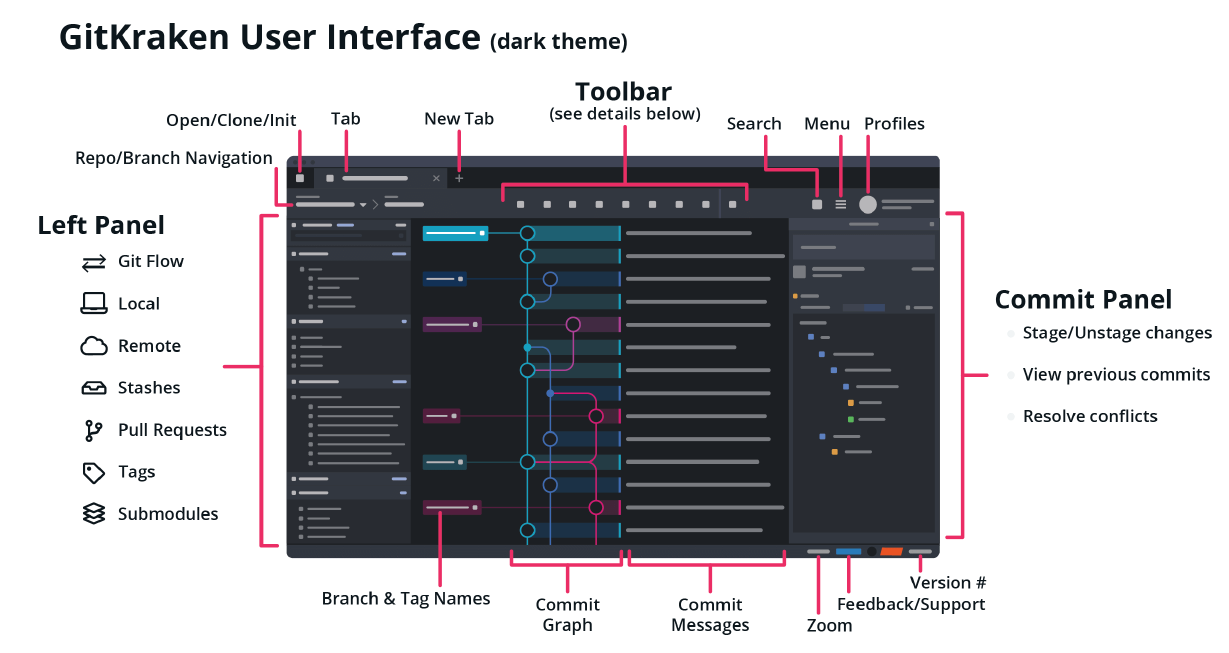
The GitKraken Git GUI, allows Big data developers to display their Git repos history. Then the code changes in a stunning techno color graph. Thus simplifies complex Git commands into drag-and — drop
behavior.
Absent a Git GUI, businesses fail to standardize Git through their development teams and scale it up.

It should not be viewed as a luxury tool, but as an integral part of your DevOps strategy. By harnessing the advantages of a GUI, Big data developers using Git can have a more efficient workflow, and these tools make collaboration a possibility.
GitKraken Enterprise and GitKraken Pro licenses are available according to the requirements of your team's environment. GitKraken Pro can be used if you can access the Internet, while GitKraken Enterprise is intended for teams in firewalled or disconnected settings. All GitKraken Enterprise and Pro
are best designed for administrators responsible for large teams or several divi


Image for post

GitKraken not only works on Linux, Mac, and Windows, but also integrates with all of our recommended Git hosting services listed in the previous section: GitHub, GitLab, Bitbucket, and Azure DevOps and their
related enterprise offerings.
Finally, one of GitKraken's best parts of the Git GUI is how accessible it is to Big data developers who are new to Git. By introducing this tool, the resources to embed new team members will be significantly reduced. Additionally , the fact that GitKraken provides an identical user interface across operating systems, in both the UI and functionality of the application, all of the Big data developers can work together, regardless of which OS they choose.
4. IDE (Environmentally Integrated Development)

The convenience they provide has made IDEs increasingly popular with software Big data developers. An IDE is a software suite that consolidates into one user interface many of the tools Big data developers use to write and test software for.
A developer must spend time without an IDE selecting, configuring and then learning how to use each new tool they adopt. Under a simple framework and a consistent UI an IDE brings everything together.
IDEs usually provide the following key developer tools:
Coding Editor
Compiler or Performer
License
IDEs can include, as well:
The Library of Code
Tester machine
Platform Testing
5. Tracker Issue
The concept of question tracking has been around for decades, but in recent years the evolution of task tracking tools has been significant. In particular, many tools have added features designed specifically for software Big data developers and development teams in a thoughtful way.
Computer development task monitoring helps individuals and teams to monitor and observe work progress from start to finish. These tools can provide useful transparency and accountability when working on a team, ensuring that everyone is on the same page when it comes to who is responsible for what and when deadlines hit.
Glo Task and Issue Tracking boards allow users to view their tasks in Kanban boards, calendar views, or as dashboards.
Glo integrates directly with GitHub and allows users to use GitHub Milestones to track large projects. Additionally, users can use GitHub Behavior to automate card manipulation on your Glo Board. These features allow less context switching, and allows Big data developers to perform and monitor tasks from the same resource across platforms.
Glo also offers an overview of timelines, courtesy of GitKraken Timelines, a tool designed to help business development teams plan and communicate project objectives and milestones.

Create-a-Mile

6. Server automation
The software development teams are constantly struggling to meet ambitious delivery deadlines and deliver quality products on time and on budget to customers. Because of unforeseen complications in configuring builds or migrating code from staging to production environments, enterprise teams which have not taken the time to refine their DevOps workflow commonly encounter challenges achieving these goals.
These problems can easily be avoided by introducing an automation server which speeds up the packaging and software delivery process and allows for automated and consistent configuration.
When something goes wrong, the automation servers provide quick feedback. If a commit breaks a project, an alert may be issued to the developer or the team (based on the configurations that you set
up). Not only is this helpful in maintaining the integrity of the build in question, it also prevents other Big data developers on the team from checking out the bad commit and further spreading the issue.
Last but not least, automation servers give your Big data developers more freedom to test on a playground without worrying about end delivery.
7. Framework Evaluation
Testing frameworks are an integral part of a successful DevOps strategy as they help to provide high- level guidelines for the creation and design of test cases; they provide a combination of practices and tools designed to help QA teams test better.
● Framework for jest-testing
● Framework tool for analyzing jests
These tools are useful to enterprise teams as they increase test speed, improve accuracy, decrease maintenance costs, and decrease error risk. Then yet another resource that will help you release on schedule and on budget tools.
Most test frameworks are composed of:
● Codification Requirements
● Methods used to handle research data
● Object repository
● Process used to store test results
● Data on how to control outside services
Software systems use direct validation of features and applications, many of which remain within the code base. As such, all of these methods are defined in one coding language since various grammar, patterns, and paradigms can be found in each language.

8. Container Administration System
Containers have become a major focus of company teams working to improve their DevOps strategy, yet another tool designed to help you meet delivery and budget targets.
Containers, one of the top enterprise app development tools, help software to run more reliably when moving from one computing environment to another. This could be from the machine of an individual developer to a test environment, from staging to production, or from a physical machine in a data center to a school virtual machine.
Problems may arise when two software systems that support it are not identical; and software is not the only complication. Differences in the topology of the network, security policies and storage capabilities
can cause problems as well.
Containers take a complete runtime environment — application and all its dependencies, libraries, and other binaries, as well as configuration files — and put everything in one package conveniently.
Conclusion
I hope you reach to a conclusion about Big Data enterprise tools. You can learn more through big data online training.

Friday, November 13, 2020

Introduction-to-big-data-hadoop-developer


Introduction to Big data

To most people, Big Data is a baffling tech term. If you mention Big Data, you could well be subjected to questions such as Is it a tool, or a product? Or Is Big Data only for big businesses? and many more such questions,More info go through Big Data and Hadoop Course


So, what is Big Data?

Today, the size or volume, complexity or variety, and the rate of growth or velocity of the data which organizations handle have reached such unbelievable levels that traditional processing and analytical tools fail to process.

Big Data is ever growing and cannot be determined concerning its size. What was considered as Big eight years ago, is no longer considered so.

For example Nokia, the telecom giant migrated to Hadoop to analyze 100 Terabytes of structured data and more than 500 Terabytes of semi-structured data.

The Hadoop Distributed File System data warehouse stored all the multi-structured data and processed data at a petabyte scale.

According to The Big Data Market report the Big Data market is expected to grow from USD 28.65 Billion in 2016 to USD 66.79 Billion by 2021.

The Big Data Hadoop Certification and Training from Simplilearn will prepare you for the Cloudera CCA175 exam. Of all the Hadoop distributions, Cloudera has the largest partner ecosystems.

This Big Data tutorial will give an overview of the course; its objectives, prerequisites, target audience and the value it will offer to you.

In the next section, we will focus on the benefits of this Hadoop Tutorial.To learn visit:big data hadoop course

Benefits of Hadoop for Organizations

Hadoop is used to overcome challenges of Distributed Systems such as -

  • High chances of system failure

  • Limited bandwidth

  • High programming complexity

In the next section, we will discuss the prerequisites for taking the Big Data tutorial.

Apache Hadoop Prerequisites

There are no prerequisites for learning Apache Hadoop from this Big Data Hadoop tutorial. However, knowledge of Core Java and SQL is beneficial.

Let’s discuss who will benefit from this Big Data tutorial.

Target Audience of the Apache Hadoop Tutorial

The Apache Hadoop Tutorial offered by Simplilearn is ideal for:

  • Software Developers and Architects

  • Analytics Professionals

  • Senior IT professionals

  • Testing and Mainframe Professionals

  • Data Management Professionals

  • Business Intelligence Professionals

  • Project Managers

  • Aspiring Data Scientists

  • Graduates looking to build a career in Big Data Analytics       

    Let us take a look at the lessons covered in this Hadoop Tutorial.

    Leszsons Covered in this Apache Hadoop Tutorial

    There are total sixteen lessons covered in this Apache Hadoop Tutorial. The lessons are listed in the table below.

    Lesson No

    Chapter Name

    What You’ll Learn

    Lesson 1

    Big Data and Hadoop Ecosystem

    In this chapter, you will be able to:

    • Understand the concept of Big Data and its challenges

    • Explain what Hadoop is and how it addresses Big Data challenges

    • Describe the Hadoop ecosystem

    Lesson 2

    HDFS and YARN

    In this chapter, you will be able to:

    • Explain Hadoop Distributed File System (HDFS)

    • Explain HDFS architecture and components

    • Describe YARN and its features

    • Explain YARN architecture

    Lesson 3

    MapReduce and Sqoop

    In this chapter, you will be able to:

    • Explain MapReduce with examples

    • Explain Sqoop with examples

    Lesson 4

    Basics of Hive and Impala

    In this chapter, you will be able to:

    • Identify the features of Hive and Impala

    • Understand the methods to interact with Hive and Impala

    Lesson 5

    Working with Hive and Impala

    In this chapter, you will be able to:

    • Explain metastore

    • Define databases and tables

    • Describe data types in Hive

    • Explain data validation

    • Explain HCatalog and its uses

    Lesson 6

    Types of Data Formats

    In this chapter, you will be able to:

    • Characterize different types of file formats

    • Explain data serialization

    Lesson 7

    Advanced Hive Concept and Data File Partitioning

    In this chapter, you will be able to:

    • Improve query performance with concepts of data file partitioning

    • Define Hive Query Language (HiveQL)

    • Define ways in which HiveQL can be extended

    Lesson 8

    Apache Flume and HBase

    In this chapter, you will be able to:

    • Explain  the meaning, extensibility, and components of Apache Flume

    • Explain the meaning, architecture, and components of HBase

    Lesson 9

    Apache Pig

    In this chapter, you will be able to:

    • Explain the basics of Apache Pig

    • Explain Apache Pig Architecture and Operations

    Lesson 10

    Basics of Apache Spark

    In this chapter, you will be able to:

    • Describe the limitations of MapReduce in Hadoop

    • Compare the batch and real-time analytics

    • Explain Spark, it’s architecture, and its advantages

    • Understand Resilient Distributed Dataset Operations

    • Compare Spark with MapReduce

    • Understand functional programming in Spark

    Lesson 11

    RDDs in Spark

    In this chapter, you will be able to:

    • Create RDDs from files and collections

    • Create RDDs based on whole records

    • List the data types supported by RDD

    • Apply single-RDD and multi-RDD transformations

    Lesson 12

    Implementation of Spark Applications

    In this chapter, you will be able to:

    • Describe SparkContext and Spark Application Cluster options

    • List the steps to run Spark on Yarn

    • List the steps to execute Spark application

    • Explain dynamic resource allocation

    • Understand the process of configuring a Spark application

    Lesson 13

    Spark Parallel Processing

    In this chapter, you will be able to:

    • Explain Spark Cluster

    • Explain Spark Partitions

    Lesson 14

    Spark RDD Optimization Techniques

    In this chapter, you will be able to:

    • Explain the concept of RDD Lineage

    • Describe the features and storage levels of RDD Persistence

    Lesson 15

    Spark Algorithm

    In this chapter, you will be able to:

    • Explain Spark Algorithm

    • Explain Graph-Parallel System

    • Describe Machine Learning

    • Explain the three C’s of Machine Learning

    Lesson 16

    Spark SQL

    In this chapter, you will be able to:

    • Identify the features of Spark SQL

    • Explain Spark Streaming and the working of stateful operations

    • Understand transformation and checkpointing in DStreams

    • Describe the architecture and configuration of Zeppelin

    • Identify the importance of Kafka in Spark SQL

                                                                                                                                      
  • To learn big data and hadoop complete course visit:   big data hadoop certification                   

Tuesday, November 10, 2020

Big Data: Overview of apache Hadoop

 The fundamental idea of MRv2 is to split up the two major functionalities of the JobTracker, resource management and job scheduling/monitoring, into separate daemons. The idea is to have a global ResourceManager (RM) and per-application ApplicationMaster (AM). An application is either a single job in the classical sense of Map-Reduce jobs or a DAG of jobs,more info go through big data hadoop course.

The ResourceManager and per-node slave, the NodeManager (NM), form the data-computation framework. The ResourceManager is the ultimate authority that arbitrates resources among all the applications in the system.

The per-application ApplicationMaster is, in effect, a framework specific library and is tasked with negotiating resources from the ResourceManager and working with the NodeManager(s) to execute and monitor the tasks.

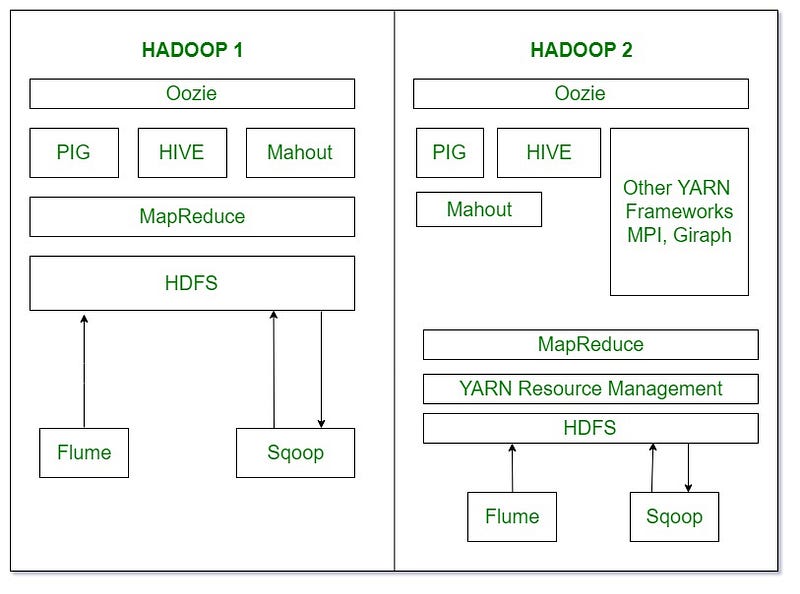
Overview of Hadoop1.0 and Hadopp2.0

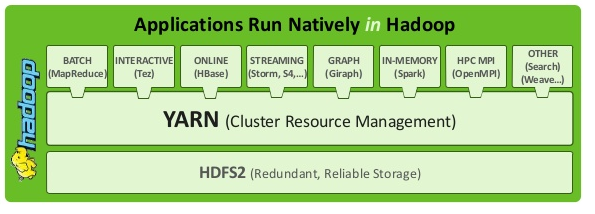
As part of Hadoop 2.0, YARN takes the resource management capabilities that were in MapReduce and packages them so they can be used by new engines. This also streamlines MapReduce to do what it does best, process data. With YARN, you can now run multiple applications in Hadoop, all sharing a common resource management. Many organizations are already building applications on YARN in order to bring them IN to Hadoop.

A next-generation framework for Hadoop data processing

As part of Hadoop 2.0, YARN takes the resource management capabilities that were in MapReduce and packages them so they can be used by new engines. This also streamlines MapReduce to do what it does best, process data. With YARN, you can now run multiple applications in Hadoop, all sharing a common resource management. Many organizations are already building applications on YARN in order to bring them IN to Hadoop.When enterprise data is made available in HDFS, it is important to have multiple ways to process that data. With Hadoop 2.0 and YARN organizations can use Hadoop for streaming, interactive and a world of other Hadoop based applications.

What YARN Does

YARN enhances the power of a Hadoop compute cluster in the following ways:

  • Scalability The processing power in data centers continues to grow quickly. Because YARN ResourceManager focuses exclusively on scheduling, it can manage those larger clusters much more easily.
  • Compatibility with MapReduce Existing MapReduce applications and users can run on top of YARN without disruption to their existing processes.
  • Improved cluster utilization. The ResourceManager is a pure scheduler that optimizes cluster utilization according to criteria such as capacity guarantees, fairness, and SLAs. Also, unlike before, there are no named map and reduce slots, which helps to better utilize cluster resources.
  • Support for workloads other than MapReduceAdditional programming models such as graph processing and iterative modeling are now possible for data processing. These added models allow enterprises to realize near real-time processing and increased ROI on their Hadoop investments.
  • AgilityWith MapReduce becoming a user-land library, it can evolve independently of the underlying resource manager layer and in a much more agile manner.

How YARN Works

The fundamental idea of YARN is to split up the two major responsibilities of the JobTracker/TaskTracker into separate entities

  • a global ResourceManager
  • a per-application ApplicationMaster.
  • a per-node slave NodeManager and
  • a per-application Container running on a NodeManager

The ResourceManager and the NodeManager form the new, and generic, system for managing applications in a distributed manner. The ResourceManager is the ultimate authority that arbitrates resources among all the applications in the system. The per-application ApplicationMaster is a framework-specific entity and is tasked with negotiating resources from the ResourceManager and working with the NodeManager(s) to execute and monitor the component tasks.\ The ResourceManager has a scheduler, which is responsible for allocating resources to the various running applications, according to constraints such as queue capacities, user-limits etc. The scheduler performs its scheduling function based on the resource requirements of the applications. The NodeManager is the per-machine slave, which is responsible for launching the applications’ containers, monitoring their resource usage (cpu, memory, disk, network) and reporting the same to the ResourceManager. Each ApplicationMaster has the responsibility of negotiating appropriate resource containers from the scheduler, tracking their status, and monitoring their progress. From the system perspective, the ApplicationMaster runs as a normal container

To learn complete course visit:big data hadoop training

Thursday, November 5, 2020

Explain Big Data testing?

 To ensure that all the features of a big data application work as intended, Big Data Testing is a testing method for a big data application. Big data testing aims to ensure that, while retaining efficiency and security, the big data system runs smoothly and error-free.

Big data is a series of massive databases that conventional computing methods can not be used to process. The testing of these datasets requires different processing instruments, methods, and frameworks. Big data refers to the creation, storage, retrieval, and analysis of information, which is remarkable in terms of volume, variety, and speed,More info go through Big Data and Hadoop Course

Strategy for Big Data Testing

Instead of testing the individual features of the software product, Big Data testing application involves more verification of its data processing. Performance and functional testing are the keys when it comes to big data testing.

The QA engineers process terabytes of data and verify using commodity clusters. Then other supporting components in Big Data testing. As processing is very fast, it requires a high level of testing skills. Moreover, there are three types of data processing.

Testing for Big Data: Functional & Performance

Data quality is also an important factor in Hadoop testing alongside this. It is necessary to check data quality before testing the application and should be considered as part of database testing. It involves checking different features, such as conformity, accuracy, duplication, consistency, validity, completeness of data, etc.

How to test Applications for Hadoop?

A high-level overview of the stages of testing big data applications is given in the points below.

Testing for Big Data: Functional & Performance

Big Data Testing can be divided broadly into three stages.

Step 1: Validation of Data Staging

Process validation is the first stage of big-data testing, also referred to as the pre-Hadoop stage.

To ensure that correct data is pulled into the system, data from various sources such as RDBMS, weblogs, social media, etc. should be validated.

Comparison of the source data with the information pushed into the Hadoop system to ensure that it matches.

Verify that the correct data is extracted and loaded into the correct location for HDFS.

For data staging validation, tools such as Talend, Datameer, can be used.

"Step 2: Validation" MapReduce

The validation of "MapReduce" is the second step. At this stage, the tester verifies the validation of business logic on each node and then validates it after running against multiple nodes, ensuring that the code validates.

Map Process Reduction works correctly.

The rules on data aggregation or segregation are enforced on data.

The generation of key-value pairs.

Validating the data after the process of Map-Reduce.

Step 3: Phase of Output Validation

The process of output validation is the final or third stage of large data testing. Based on the requirement, the output data files are generated and ready to be moved to an EDW (Enterprise Data Warehouse) or any other system.

Third-stage activities include

  • The transformation rules are correctly implemented to check

  • Checking the integrity of the data and the successful load of data into the target system.

  • Compare the target data with the HDFS file system data system to check that there is no data corruption.

Testing Architecture

Hadoop processes very large data volumes and is extremely resource-intensive. To ensure the success of your large Data project, architectural testing is therefore crucial. A poorly or improperly designed system may lead to degradation of performance, and the system may fail to meet the requirements. In a Hadoop environment, at least Performance and Failover test services should perform.

Performance testing involves job completion time testing, memory utilization, data throughput, and similar metrics of the system. While the purpose of the Failover test service is to verify that data processing happens seamlessly in the event of a data node failure.

Testing for Performance

Two key actions for Big Data performance testing are as follows.


Data intake and throughout: 

The tester verifies in this stage how data from different data sources can be consumed by the fast system. Testing involves identifying a different message that in a given time frame can be processed by the queue. For example, the insertion rate in a Mongo and Cassandra database includes how quickly data can be inserted into the underlying data store.

Data Processing: 

It involves verifying the speed at which jobs are executed by queries or map reduction. When the underlying data store is populated within the data sets, it also involves testing the data processing in isolation. For instance, on the underlying HDFSS, running Map-Reduce jobs

Sub-Component Performance:

These systems consist of multiple components and each of these components needs to be tested in isolation. For instance, how fast the message is indexed and consumed, MapReduce jobs, the performance of queries, search, etc.

Performance Approach Testing

Big data application performance testing involves testing huge volumes of structured and unstructured data, and a specific testing approach is required to test such massive data.

Testing for Big Data: Practical & Efficiency

In this order, Performance Testing carries out as follows.

The method starts with the setting of the Big Data cluster to be tested for performance.

Identify and design matching workloads

(Custom scripts are created) Prepare individual clients

Execute the test and analyze the result (tune the component and re-execute if targets are not met)

Configuring Optimum

The Performance Testing Parameters

For performance testing, various parameters to verify are as follows.

  • Storage of Data: 

How data is stored in different nodes

  • Commit logs: 

How large can the commit log grow?

  • Concurrency: 

How many threads can operate in writing and reading

  • Caching: 

You can tune row cache settings.

  • Timeouts:

Connection timeout, query timeout, etc. values.

  • JVM Parameters: 

Heap size, algorithms for GC collection, etc.

  • Performance reduction map: 

sort, merge, etc.

  • The queue for messages: 

Message rate, size, etc.

Needs for Test Environments

The test environment must rely on the type of application that you are testing. The test environment for large data testing should include the test environment.

  • A large amount of data should have enough space for storage and processing.

  • A cluster with distributed nodes and data should be present.

  • To maintain high performance, it should have minimal CPU and memory use.

  • Large Data Research Issues

The automation

Big data automation research needs someone who has professional knowledge. Automated tools are often not designed to deal with unforeseen issues that occur during research.

Virtualization

It is one of the main stages of research. In real-time, large data testing, virtual machine latency causes timing issues. Managing images in this technology is also a concern.

Broad Dataset

You need to check more data and do so more quickly.

Need to automate the effort for testing

The need to be able to test through multiple platforms

Challenges with Performance Testing

  • Diverse technology set: 

Each sub-component is part of various technologies and needs isolation testing.

  • Unavailability of specialized tools:

 End-to-end testing can not be done by a single instrument. NoSQL would not work for message queues, for instance,

  • Test Scripting: 

The creation of test scenarios and test cases involves a high degree of scripting.

  • Test environment: 

Because of the huge data size, it requires a specific test environment.

  • Monitoring Solution: 

Few solutions can monitor the whole environment.

  • Diagnostic Approach: 

  • To drill down the output bottleneck areas, a personalized solution needs to create.

Conclusion

I hope you conclude testing using big data. You can learn more about big data testing from Big data and Hadoop online training.